Intersect™ 2026.3 now available
Friday, 25 September 2026
The Intersect simulator supports NVIDIA’s Blackwell GPU architecture, including both data center and workstation GPUs across NVIDIA B200, B300, and the RTX PRO Blackwell Server and Workstation Edition series.
This update delivers a major improvement in multi‑GPU performance and scalability. This was achieved by reducing both the amount of data transferred between GPUs and how often GPUs need to communicate.
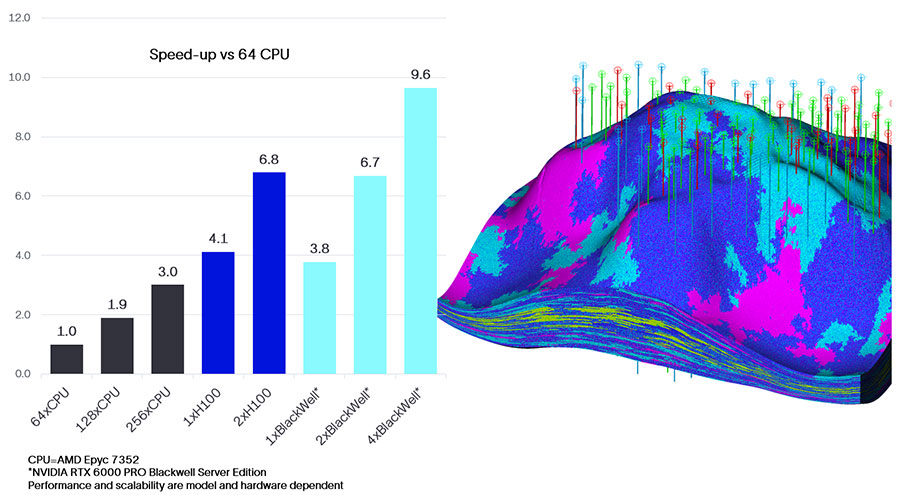
Scalability over modern CPU and GPU hardware performed using a 10 million cell model, highly heterogeneous analogue of Brazilian pre-salt.
EDFM now supports thermal simulation, extending fracture modeling capabilities to capture heat transfer within hydraulic and natural fractures, as well as between fractures and the surrounding rock matrix.
This enhancement enables engineers to evaluate temperature-driven changes in fluid and rock properties in natural and hydraulically fractured reservoirs undergoing thermal recovery processes, and in geothermal applications. The capability builds on the proven thermal simulation framework of the Intersect simulator, including matrix rock thermal behavior, wellbore heat-loss modeling, with overburden and underburden heat exchange, and temperature-dependent fluid properties.
Together, these capabilities provide a more complete foundation for optimizing geothermal and thermal recovery applications, including completion design, well placement, and circulation strategies. Variable thermal conductivity models for EDFM are not supported in this release.
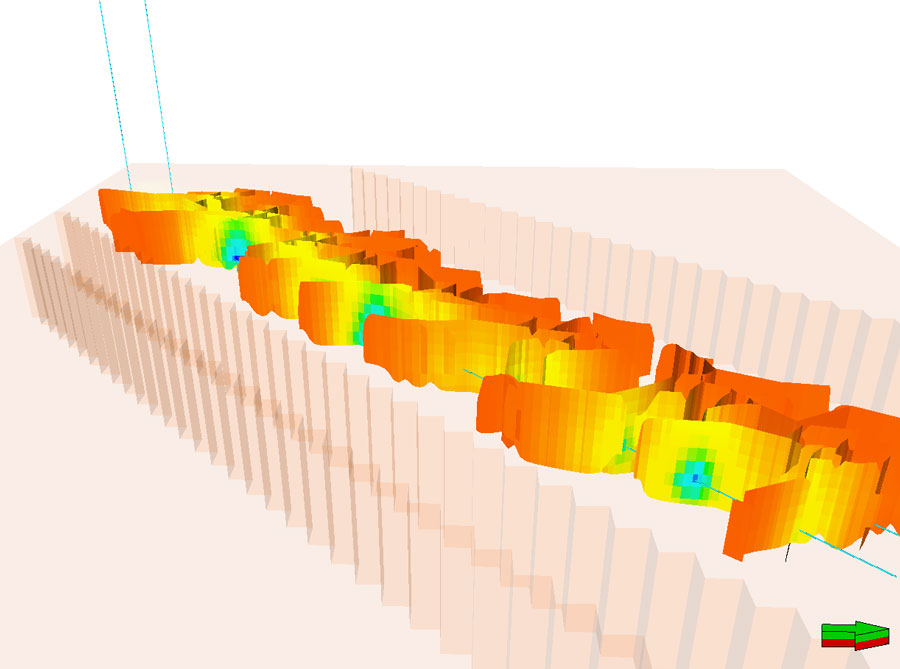
Thermal effect modeled with embedded discrete fracture modeling (EDFM)
With Intersect 2026.3, Visage™ 2026.1, and Petrel™ 2026.1, users can now directly couple Intersect simulator and Visage finite-element geomechanics simulator cases with EDFM grids, improving the simulation of complex fractured reservoirs and unconventional shale assets. Direct coupling with the Visage simulator allows the simulation to account for the interaction between fluid pressure within the fracture network and the effective stress on fracture planes provided by the Visage simulator. This enables more accurate and robust modeling of fluid flow through naturally occurring and hydraulically created fractures.
This integration enables the model to capture stress-induced changes in fracture aperture and permeability, delivering a more dynamic and realistic representation of how stress variations from reservoir depletion affect fluid-flow pathways. Using the coupled approach in EDFM cases helps users better understand and forecast production performance in fractured reservoirs where geomechanical effects play a significant role.
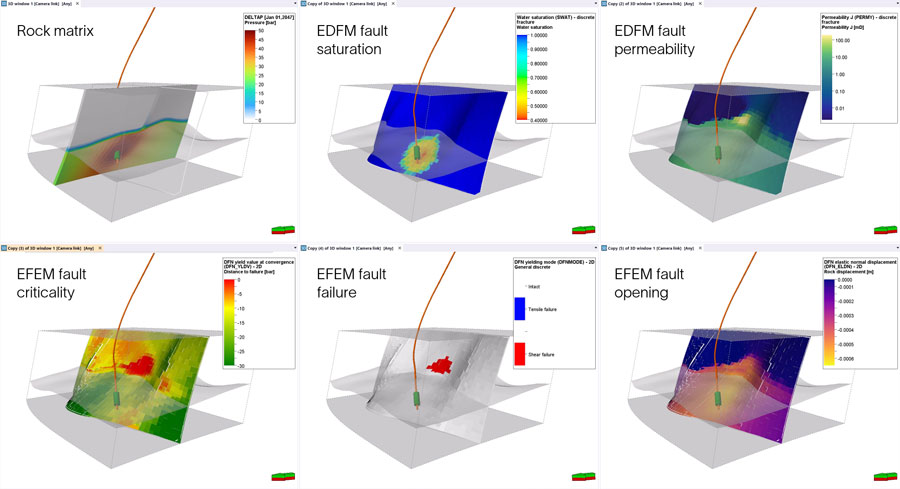
Higher fidelity and better visualization of EFEM fault and fracture results displayed on 2D patches
Learn more about the Intersect simulator


