Intersect 2026.2 now available
Friday, 03 July 2026
The GPU linear solver has undergone extensive development to fully utilize newer and more powerful GPU devices. Significant performance improvements can be observed in both single and multi-GPU simulations with the new default behaviors, with an average of 1.5 times speed-up relative to the previous version observed in a suite of representative test models.
The GPU linear solver has been enhanced to maximize performance on modern GPU hardware. With enhanced default behavior, users can achieve significantly faster simulation runtimes across both single-GPU and multi-GPU configurations. Benchmark testing on a representative set of models shows an average performance improvement of up to 50%, delivering faster insights and improved productivity.
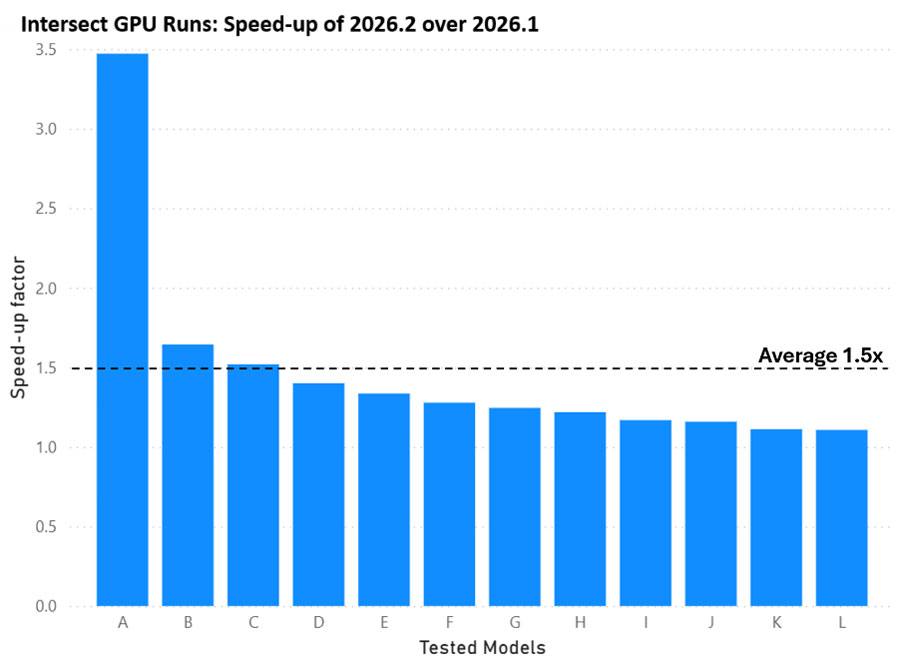
Enhancements to the GPU linear solver bring speed-ups across a suite of tested models
The multiscale sequential fully implicit (SFI) transport solver has been optimized for fractured reservoir simulations, using the embedded discrete fracture model (EDFM), providing both higher solution accuracy and significantly faster runtimes. In tested cases, the enhanced solver delivered performance gains by orders of magnitude, accelerating simulation workflows while maintaining reliable results.
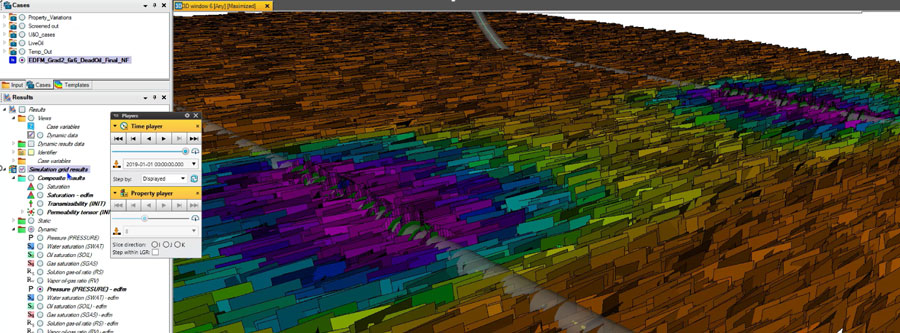
EDFM cases representing natural and hydraulic fractures have been made faster with the Multiscale SFI solver
The thermal well model has been enhanced to account for potential energy, improving the accuracy of temperature predictions along the wellbore. This contribution can be particularly significant for deep wells and near-adiabatic systems. This enhancement enables more realistic modeling of temperature predictions along the wellbore, and is especially beneficial for applications such as geothermal reservoirs, where these conditions may be encountered.
Learn more about the Intersect™ reservoir simulator
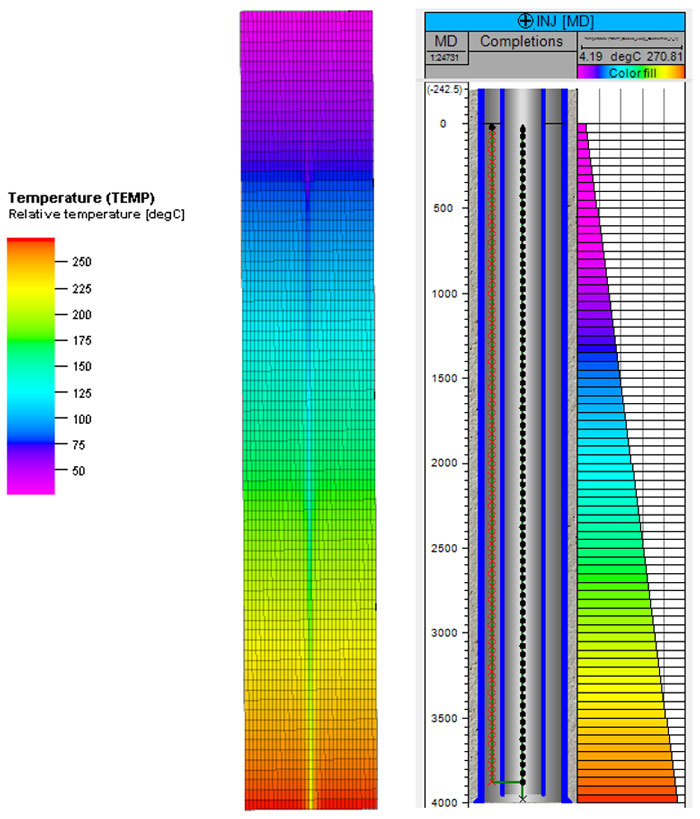
The well model has been extended for a more accurate representation of deep wells with thermal considerations


