New Software Release

Intersect™ 2025.4 now available

Friday, 12 December 2025

The release of Intersect™ reservoir simulator 2025.4 delivers many key features in performance, field management, and more.

Key release highlights


The Intersect simulator now supports multi-graphics processing unit (GPU) simulation enabling breakthrough performance on the most complex reservoir models

Intersect will now run with multiple parallel processes on NVDIA® GPUs. This enables you to use more than one GPU when running the Intersect simulator. By making use of the advances in modern GPU cards, multi-GPU allows engineers to run larger models, faster.
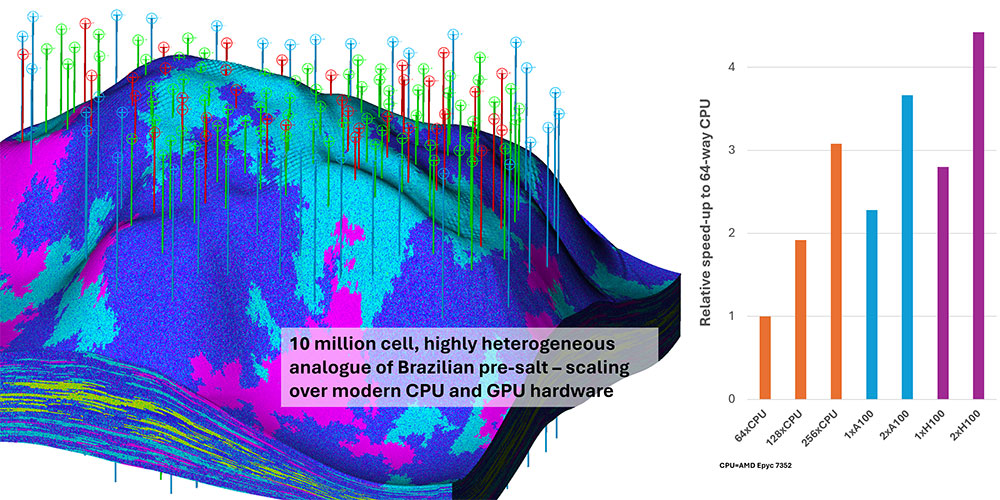
 

Intersect 2025.4
Intersect has scalability to make the best use of modern CPU and GPU hardware.


Introducing IxNetwork—a next generation fully implicit network solver for faster and more stable reservoir to surface integration

IxNetwork is a new implicit network solver that allows for faster and more stable integration of the reservoir and the surface production network within the Intersect simulator. It does so through a general, pipe-flow tabular description that is solved implicitly with the reservoir. In addition to the new solver, a converter from Eclipse network solver (ENS) models to the new format is also available.
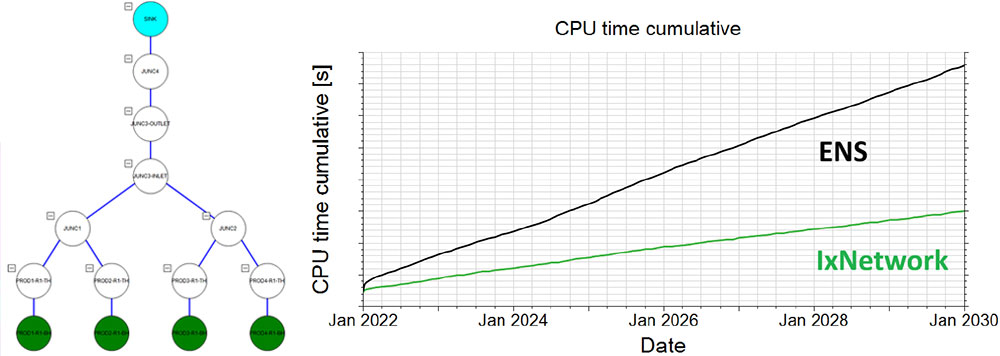
 

Intersect 2025.4
IxNetwork provides a fast and stable solution for surface networks, superior to other coupling types.


Geoscreening engine—now available in multiscale for more confident reservoir modeling

A geologic screening engine is now available within the multiscale framework. It enables you to quickly set up and run, at low computational cost, numerical experiments on entire ensembles to rank, screen, and select geologic models. This captures the impact of uncertainty and lowers risks associated with field development planning.
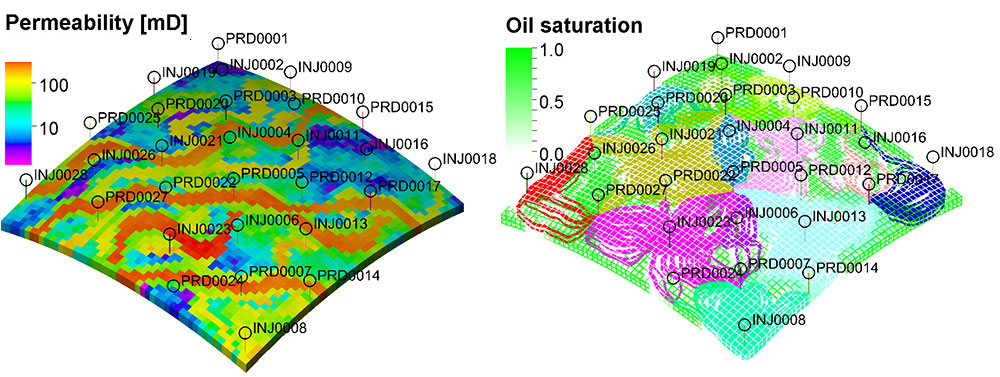
 

Intersect 2025.4
The geoscreening engine allows to quickly evaluate the dynamic behavior of geologic models.


Learn more about the Intersect reservoir simulator

Key enhancements


Performance

  • A new dissipation-based continuation method has been implemented for faster simulation runs through improved convergence. It is beneficial for modeling contrasting media such as complex fractured reservoirs, embedded discrete fracture models (EDFM). Up to 15x speed-ups were observed in target cases.
     

Physics and new energies

  • Grid independent property edits using XYZ coordinates, and geological layers (L) are now available. They can be particularly useful for grids where IJK (index-based) numbering is not meaningful, such as depogrids or unstructured grids, unlocking history-matching workflows for such models. The edits can also be carried across grid realizations of different resolutions.
     
  • Component and fluid phase enthalpies can now be computed from an equation of state (EoS). This is compatible with all thermal models, including carbon storage challenges such as the injection of CO2 in depleted gas reservoirs. The option also makes fluid phase properties such as density, enthalpy, and internal energy more consistent.
     
  • You can now automatically update permeability from porosity using established correlations such as Carman-Kozeny, Beattie-Boberg, and Lebel. This enhances modeling of workflows that involve considerable changes in pore volume, such as rock compaction, solid deposition, and adsorption.
     
  • Hydrate formation detection is now available through a custom hydrate formation table that defines formation temperature versus pressure and mole fraction. When conditions are met, 2D and 3D reports will show reservoir cells which would exhibit hydrate formation.
     
  • Material balance error calculation, when using the component mole normalization method, has been improved for cases which are sensible to trace amounts of components.
     

Usability

  • Support for wildcards has been extended, allowing you to use wildcarded lists directly without the need of creating intermediate static lists.
     
  • Entering report labels is now optional when requesting summary or 3D (both initial and recurrent) property reports. The simulator will make use of default report labels as available.
     
  • Compatibility with Pipesim™ steady-state multiphase flow simulator versions for coupling has been extended, with versions 2025.1 and 2025.2 now also being supported.