Drillbench 2025.2 now available
Monday, 06 July 2026
Drillbench™ 2025.2 includes an upgrade from Olga™ dynamic multiphase flow simulator 2025.1 to Olga simulator 2025.2.1, which resolves stability issues reported by users in certain complex flow scenarios. In addition to the engine upgrade, this release introduces new plotting capabilities, workflow enhancements for Drillbench dynamic well control and Drillbench blowout control, and targeted bug fixes across all modules—including resolution of several issues that were previously documented in the Known Issues section.
The Olga simulation engine used in both Drillbench dynamic well control and Drillbench blowout control has been upgraded from version Olga 2025.1 to Olga 2025.2.1. This upgrade accumulates improvements from two intermediate engine versions between the previous and current release, in addition to the targeted stability fixes described in the release overview. Relevant improvements include corrections to multi-phase flow calculations in counter-current scenarios—such as kick migration and u-tubing events—improved robustness for certain pipe geometries and fluid conditions that could previously cause unexpected simulation failures, and improved handling of fluid properties at phase boundaries. For simulations started from a previously saved state, unnecessary reductions in simulation time step at startup have also been eliminated.
Users upgrading from Drillbench 2025.1.x should review their simulation results in cases involving significant u-tubing or counter-current flow, as some of these corrections may produce marginally different outcomes compared to the previous version.
It is now possible to start Drillbench dynamic well control (DWC) and Drillbench blowout control (DBC) simulations simultaneously from within the same Drillbench session. Previously, users had to wait for one simulation to be initialized before launching the other. This enhancement improves workflow efficiency for engineers who need to run parallel analyses across both modules.
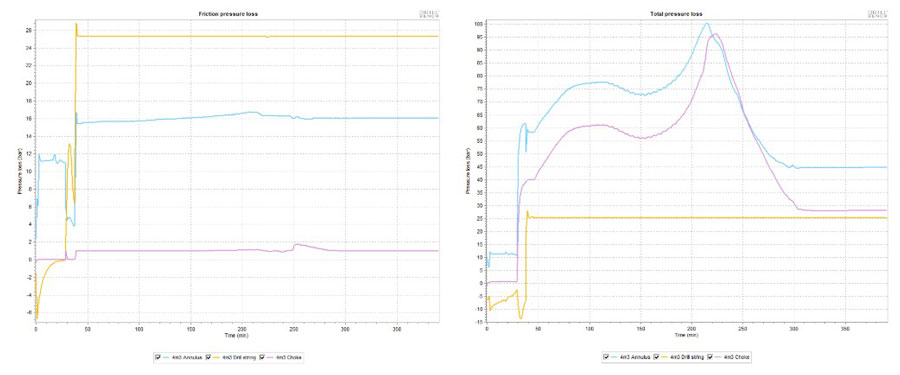
A new dedicated frictional pressure trend and profile plot has been added to Drillbench dynamic well control. In previous versions, the frictional pressure loss plot combined frictional contributions with additional pressure losses (such as choke and valve losses), making it difficult to isolate pure friction effects. The new plot displays frictional pressure exclusively, providing a clearer view of wellbore pressure distribution and simplifying the diagnosis of friction-related behavior in the drill string and annulus. This resolves the known limitation documented in previous release notes.
Drillbench blowout control has been updated to handle near-atmospheric wellbore pressures more robustly, bringing it in line with behavior already present in Drillbench dynamic well control.
In certain blowout scenarios—particularly during relief well kill operations—wellbore pressures can drop dramatically. A representative case is the rapid drainage of kill lines, which causes fluid levels to fall sharply and combined with u-tubing dynamics, can drive wellbore pressures down toward or below atmospheric. In previous releases, these conditions could cause the simulation to become numerically unstable or produce physically unrealistic results, making it difficult to obtain reliable estimates of blowing rate and bottomhole pressure in these extreme scenarios.
This release introduces more robust handling of these low-pressure conditions. The simulation now applies safeguards to maintain physically consistent fluid behavior as pressures approach atmospheric levels, preventing the breakdown that could occur in earlier versions.
Users should be aware that this change may produce different simulation results in cases where pronounced u-tubing leads to near-vacuum wellbore conditions. Specifically, the rate at which mud levels drop may be affected, which in turn influences the calculated bottomhole pressure and blowing rate. Users comparing 2025.2 results against earlier releases for scenarios involving deep vacuum conditions should expect some differences in these quantities.
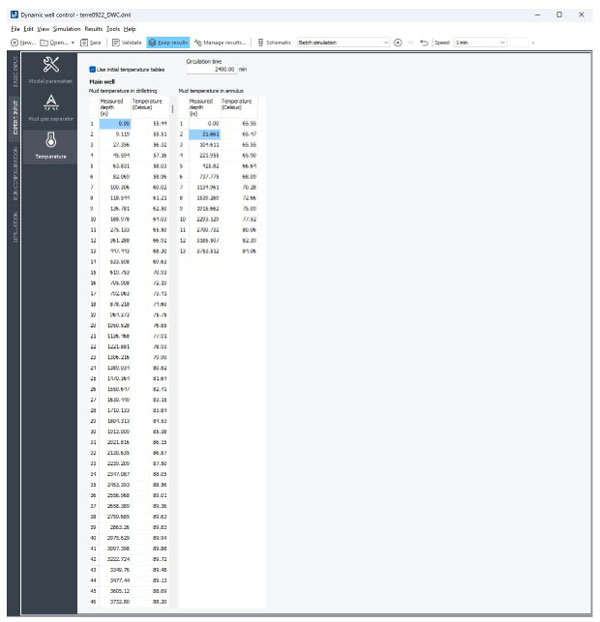
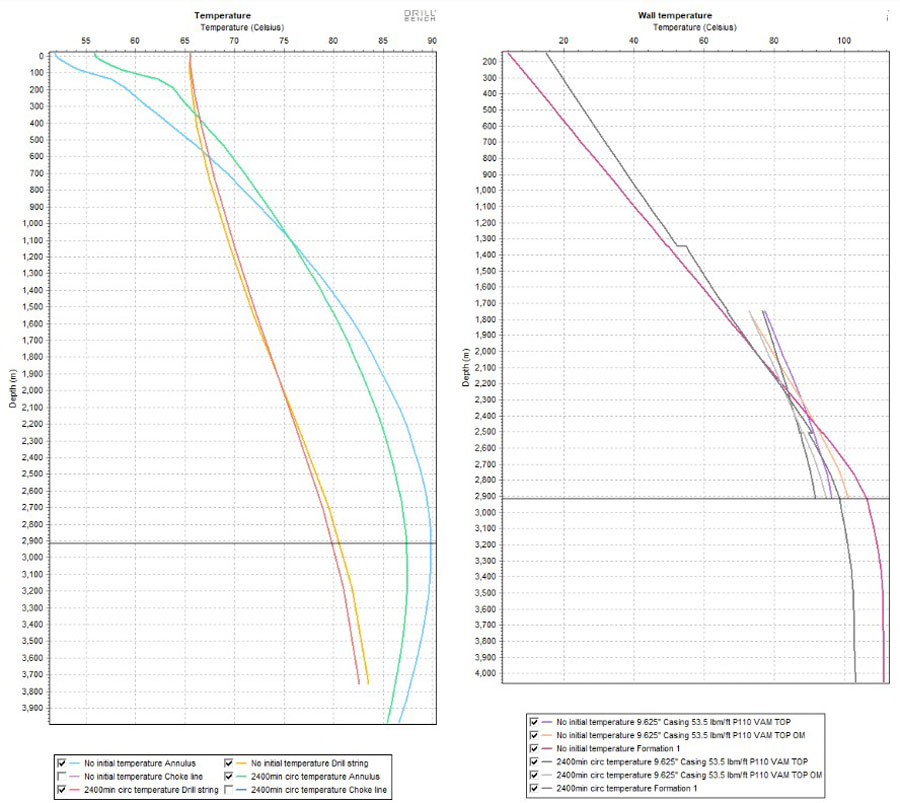
A new option to specify the initial temperature of the drillstring and annulus fluids has been added to both Drillbench dynamic well control and Drillbench blowout control. The input is located in the Expert tab of each module, allowing users to override the default temperature initialization used at the start of a simulation.
The specified fluid temperatures are propagated into the surrounding wellbore, casing, and cement through the existing Circulation time input. The circulation time defines how long the specified temperature profile is assumed to have been present prior to the start of the simulation, and the formation, casing, and cement temperatures are heated or cooled accordingly. As an example, a circulation time of 540 minutes will let the surrounding materials equilibrate toward the user-defined fluid temperature over that duration before the simulation begins.
This option is intended for cases where the default temperature initialization does not represent the operational state being modeled—for example, when starting a simulation after an extended circulation period or following a static interval where the wellbore has cooled. Users should ensure that the circulation time selected reflects the physical scenario being represented, as it directly influences the initial temperature distribution and therefore the early-time wellbore thermal response.