Olga 2026 is Available Now
Wednesday, 17 December 2025
The Olga™ dynamic multiphase flow simulator models transient flow (time-dependent behaviors) to maximize production potential. Transient modeling is an essential component for feasibility studies and field development design. Dynamic simulation is essential in deep water and is used extensively in both offshore and onshore developments to investigate transient behavior in pipelines and wellbores. Transient simulation with the Olga simulator provides an added dimension to steady-state analysis by predicting system dynamics, such as time-varying changes in flow rates, fluid compositions, temperature, solids deposition, and operational changes. The Olga simulator accurately predicts transient flow behavior across the entire production system—from wellbore dynamics through well completions to pipelines and associated process equipment.
As part of our ongoing commitment to excellence, we continuously innovate to enhance our product. This latest version brings multiple improvements, updates, and bug-fixes to benefit our users. The most important improvements are mentioned in this document below. Please read the release notes for the full overview.
Update of Symmetry Library
The latest Symmetry™ fluid engine release brings major stability and accuracy improvements for Olga compositional tracking and Symmetry flashes. Key highlights include:
Update of Multiflash Library
The KBC Multiflash library has been upgraded from 7.5 to 7.6, delivering improved accuracy and robustness for compositional tracking simulations. Highlights include:
Additional improvements:
Update of PVTSim Library
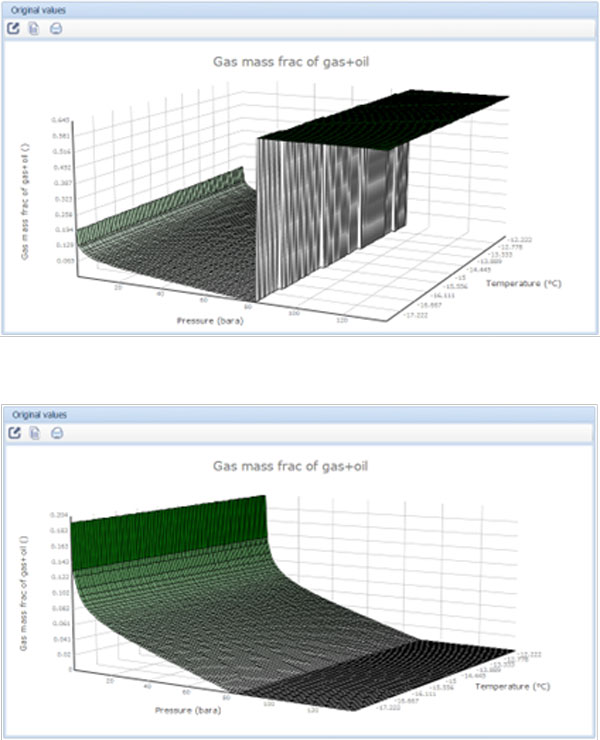
The latest PVTSim Nova 7.2 release introduces key enhancements for Olga simulator integration:
 /p>
/p>
Directional leak functionality
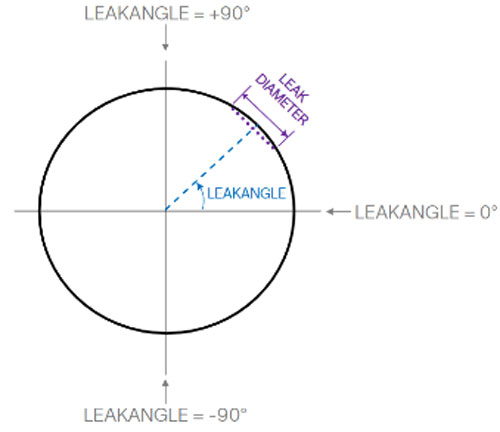
The new directional leak feature improves depressurization simulations for stratified flow regimes, where gas sits above liquid in the pipeline. Unlike the default model (which assumes a well-mixed fluid), this functionality calculates leaked gas and liquid fractions based on:
This allows more realistic modeling of leaks dominated by either gas or liquid, depending on their position. Directional leak is only compatible with Olga new solver (CCS) in Olga 2026.1.
 /p>
/p>
Equilibrium fluid model for pumps and compressors
Olga simulator now supports a new FLUIDMODEL key for centrifugal pumps and compressors, with two options:
CO₂ flow model
A dedicated CO₂ flow model is now available when the solver option is set to Olga new solver (CCS) and the flow model is set to Olga. It is designed for CO₂-dominated gas–liquid two-phase flow and ensures accurate simulation for these conditions. Compared to the Olga friction factor model, the pressure drop error is reduced by 51%, the hold-up error is decreased by approximately 31%, and the accuracy of flow regime prediction is increased by 34%.
|
|
Error on the pressure drop |
Error on the hold up |
Flow regime prediction accuracy |
|
Reduced by 51% |
Reduced by 31% |
Increased by 34% |
Table 1 - Improvements for the CO2 model compared to the Olga friction factor flow model
Security enhancements
As part of SLB’s Software Lifecycle Management process, SLB will conduct tests to ensure that the software is free from security vulnerabilities and malicious codes, including viruses, trapdoors, trojan horses, or ransomware that could render the software inoperable or prevent its use as documented. If SLB becomes aware of such a threat, it will use commercially reasonable efforts to provide a patch or updated version of the software to eliminate or mitigate the issue, making it available for download or installation by the customer. SLB is not responsible for viruses introduced at the customer’s site or those that did not originate from the software.
With increased focus on security from both customers and internal initiatives, three scanning tools have been introduced for Olga simulator: Mend, Spectra Assure and FlexNet from Flexera. These tools scan for vulnerabilities and enable updates or replacement of outdated libraries.
Additionally, a penetration test was conducted on Olga simulator by a third-party company, which was successfully completed from the project’s perspective.
New output variables
Two new reservoir output variables have been added:
These variables provide enhanced monitoring and analysis capabilities for reservoir performance.
Additional variables have been added to capture and locate the minimum and maximum inner wall surface temperature (TWS) in branches.
Node function improvements
Several updates have been made to node functionality:
Olga simulator cases created in version 2025.2 or earlier that include mass or internal nodes are automatically converted to manifold nodes when opened in the current Olga UI. Cases using manifold nodes are not backward compatible with older versions.
Steady-state preprocessor enhancements
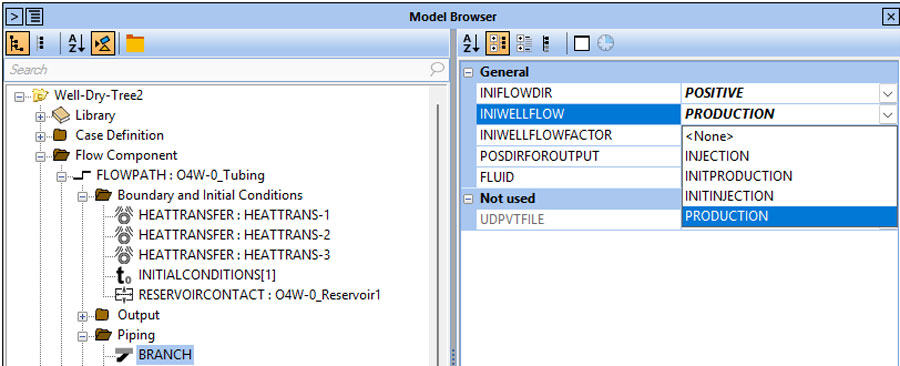
The steady-state preprocessor (SSPP) now includes support for injection wells and negative pressure-driven sources, enabling more accurate modeling of CCS injection and drilling scenarios.
New options have been added to the steady-state preprocessor for RESREVOIRCONTACT through a new key INIWELLFLOW under BRANCH keyword. The following options are available:
Performance improvements
Computational speed in the Olga simulator has been significantly increased through enhanced parallel processing.
Parallel processing has been optimized, providing additional benefits for running parallel simulations across most computer architectures. This improvement typically reduces simulation time by a factor of two to three (case-dependent) compared to Olga 2025.2. running simulations on four threads.
The product is suitable for use by production, process, and flow assurance engineers, and those involved in multiphase flow simulation.


