The release of Intersect™ 2026.1 delivers many key features in physics, field management, performance, and more.
Key release highlights
New asphaltene modeling capability for improved reservoir performance prediction
An asphaltene model has been introduced to provide a framework for modeling asphaltene formation and its impact on reservoir performance. The model captures the asphaltene phases, from precipitation and flocculation to deposition, and quantifies their effects on fluid viscosity and reservoir permeability.
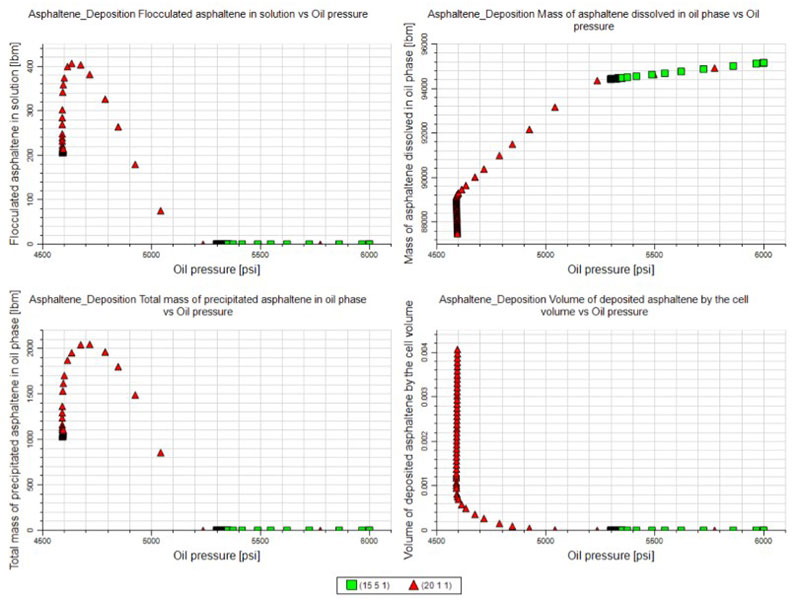
(L-R) The Intersect™ reservoir simulator now has a dedicated model for asphaltene formation in all its phases
Confidently honor water and gas injection facility constraints with IxNetwork
You can now model gas and water injection networks in addition to production networks using IxNetwork fully implicit network coupling. This ensures that water and gas injection facility constraints are accurately honored. IxNetwork is a new implicit network solver that delivers faster and more stable integration of the reservoir and the surface production network within the Intersect simulator.
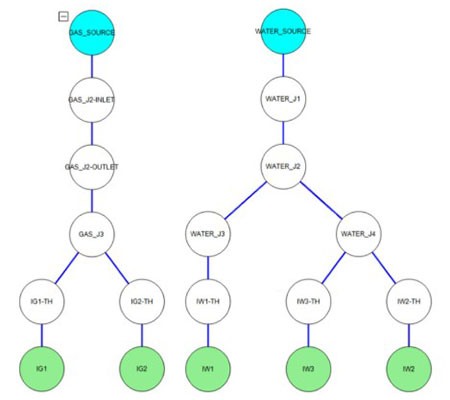
IxNetwork’s fast and stable solution for surface networks, now extended to injection networks
Comprehensive simulation of fracture behavior with projection-based embedded discrete fracture modeling (pEDFM)
Building on the embedded discrete fracture modelling (EDFM) capabilities first introduced in Intersect 2024.1, this release extends the method with projection-based capabilities that enable accurate representation of flow-reducing or blocking fractures. This delivers a more realistic simulation of fracture behaviors.
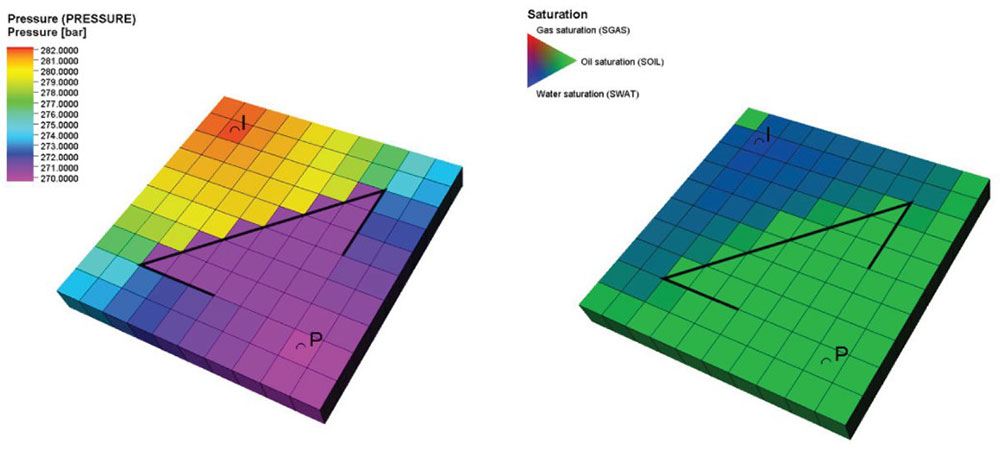
The pEDFM methodology can capture behavior of sealing fractures while avoiding complex re-gridding
Learn more about the Intersect reservoir simulator
Key enhancements
Performance
- EDFM and dual porosity (DP) cases run with multiscale sequential fully implicit (SFI) solver have been made faster by applying a numerical technique known as velocity scaling, which stabilizes the upwind direction of the total flux.
- Multiscale SFI is now compatible with the multiple realization licensing scheme. This allows for signed runs from Petrel™ subsurface software and MEPO™ multiple realization optimizer using multiscale SFI to have more rationalized license usage across realizations.
Physics and new energies
- To account for the physics of brine injection into reservoirs with complex wettability behavior, you can now combine capillary pressure hysteresis and low salinity flooding models.
- The Intersect simulator now supports the combination of residual oil saturation with component solubility in water, in isothermal models. This enables improved modeling of scenarios such as CO2 injection into depleted oil reservoirs.
- To better support varied axis and coordinate systems used by pre- and post-processors, the Intersect simulator includes new options for configuring XYZ offset coordinates and XYZ axis scaling for use with grid independent property edits. When set, these values are automatically applied to XYZ property edits performed in the BoxPropertyEdit node
Field management
- When using the Eclipse™ Network Solver, user-supplied branch names can now be provided. These branch names are useful in Eclipse Network Solver and Intersect simulator reporting, and in field management specifications that require a branch name.
Usability
- Two new workflow examples have been added to illustrate the modeling of geothermal systems. These examples introduce the key physical processes involved and demonstrate how to set up and run simulations for each system. They showcase commonly used modelling features, including heat flux boundary conditions, single component hydrocarbon fluids, enthalpy calculated from an equation of state, and multi-segment wells.


